
The Rushing Syndrome
Why You Feel Overwhelmed (And Why Doing More Won’t Fix It)

When you feel overwhelmed, the instinct is immediate:
do more, move faster, catch up.
Clear the inbox.
Push through the list.
Get ahead of it.
It feels productive.
But it doesn’t resolve the overwhelm.
It amplifies it.
Because speed does not resolve overwhelm.
It reinforces it.
The Rushing Response
It speeds them up.
You start moving quicker.
Thinking faster.
Stacking tasks.
There’s a subtle urgency underneath everything.
Not always visible, but always present.
I know this pattern well. For a long time, my response to pressure was to speed up.
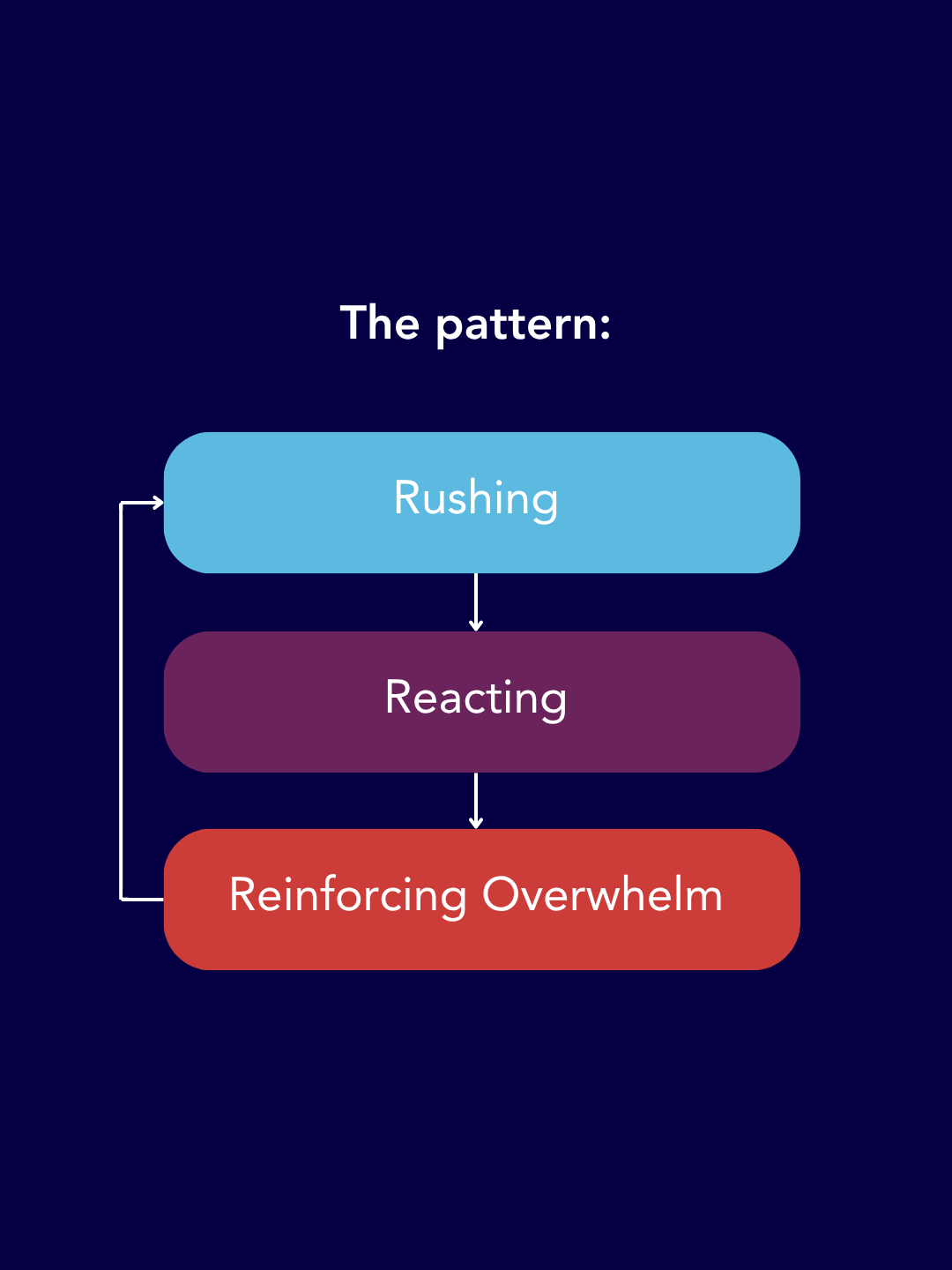
This is what I call the rushing syndrome.
Why It Doesn’t Work
The assumption is:
“If I do more, I’ll feel less overwhelmed.”
But overwhelm is not created by the volume of tasks alone.
It is created by the state you are operating from.
This is why so many high-performing leaders still feel overwhelmed, even when they’re doing more.
When your system is overloaded:
- perception narrows
- prioritisation weakens
- decision-making becomes reactive
You may be doing more.
But you are operating with less clarity.
You’re operating from scarcity.
Time feels limited. Resources feel stretched.

More Action, Less Capacity
External demand increases.
Internal capacity does not.
So what happens?
You compensate with effort.
You push harder.
You stay on longer.
You override signals.
From the outside, it looks like productivity.
From the inside, it feels like pressure.
The Cost of Constant Rushing
It disconnects you from your body.
It reduces your ability to think clearly.
It creates a loop where urgency feeds more urgency.
And over time, it becomes your baseline.
You start living in it.
Why Slowing Down Feels Uncomfortable
This is where the paradigm needs to shift.
Slowing down feels counter intuitive.
Even unsafe.
But slow is fast.
Because the identity has been built around:
Being efficient
Being responsive
Being ahead
So when you pause, something feels off.
Like you’re falling behind.
Even when you’re not.
The Real Shift
Overwhelm is not solved by doing more.
It is solved by increasing your capacity to hold what’s already there.
That means:
- regulating the system before reacting
- creating space before acting
- returning to clarity before deciding
What This Looks Like in Practice
Not less responsibility.
But a different way of operating.
You move from:
Urgency → Intentional pace
Reaction → Response
Force → Capacity
Where This Leads
When the internal system stabilises:
- decisions become clearer
- action becomes more efficient
- energy becomes sustainable
You stop chasing.
Final Thought
It is stability.
Because doing more will not calm a system that is already overloaded.
Only capacity will.
Read More here:

Why Strategy Alone Doesn’t Create Results
The Somatic Side of Growth I see it often in my work. A client knows exactly what to do. The strategy is clear. The next step is obvious. And yet, when it’s time to act, something resists. Execution is inconsistent. Visibility fluctuates. Momentum comes in waves. This...

Leadership Presence Begins in the Body
Why Awareness Shapes Authority In business, the word agile appears everywhere. Agile leadership. Agile organisations. Agile strategy. We use the word constantly to describe the ability to adapt quickly. To move with change. To respond to complexity. But there is...

Work-life balance is a myth
So is hustle cultureThe False Binary Most high-performing leaders already know this. You do not want a rigid nine-to-five structure. You do not want to switch off at 5pm simply because someone once decided that was “healthy”. You might love working at night. You might...